Showing posts with label Jelly Bean. Show all posts

Tuesday, December 31, 2013

Sprint HTC EVO 4G LTE Android 4.3 Update Confirmed For February

HTC’s Jason Mackenzie confirmed on Twitter that carrier testing of the update will start in mid-January with the consumer release scheduled for mid-February.
The Android 4.3 update for the Sprint HTC EVO 4G LTE will include all the usual features from Google plus a major facelift for the UI as the phone will be getting HTC Sense 5. It’s still unclear if the HTC EVO 4G LTE will eventually be upgraded to KitKat (Android 4.4). The phone is essentially a re-branded version of the HTC One X, but even that phone hasn’t officially been blessed as an Android 4.4 update candidate.
Since HTC is being transparent about the end-to-end update process for its deviceshere in the US, let’s hope they can sort things out and let consumers know if they should be expecting the latest version of Android on HTC’s 2012 flagship phones.

Source: HTCSource

Friday, August 9, 2013

Nexus 7 2013 Factory Images And Binaries Now Live

Screen Shot 2013-08-09 at 3.18.17 PM

The factory images for the new Nexus 7 2013 “razor” are now live. The binaries too. We’re looking at Android 4.3, build JSS15J.
Be sure to download the factory images and store them in a safe place, you never know when you might need to flash your device back to stock.

Wednesday, July 24, 2013

Google Announces Android 4.3 Jelly Bean


Google today announced a minor bump in its Android platform to version 4.3 Jelly Bean. The core new features of Android 4.3 include the addition of restricted profiles to the multi-user tool, which lets users control what apps/services can be accessed by the other users. Android 4.3 adds support for Bluetooth 4.0 Low Energy, also called Bluetooth Smart. This will let Android 4.3 devices interact with new Bluetooth accessories, such as heart rate monitors. 

Android 4.3 also adds support for OpenGL ES 3.0 for improved graphics in games. The updated operating system offers new digital rights management APIs, which will eventually lead to the availability of more full HD 1080p video from third-party providers such as Netflix. Android 4.3 also adds a wide range of tools for developers, such as optimized location and sensor capabilities, improved access to notifications, more languages, user interface automation, and improved enterprise security tools, such as WPA-2 Wi-Fi networks. The Google Nexus 7, a new tablet from Google, will be the first device to ship with Android 4.3, but Google will deliver Android 4.3 to the Nexus 4, Galaxy Nexus, and first-generation Nexus 7 devices.


Source: Google

Thursday, May 16, 2013

Google Updates Google TV With Android Jelly Bean 4.2.2


Google TV didn't receive any stage time today at the Google I/O keynote, it will be receiving Android Jelly Bean 4.2.2 and the latest version of Chrome. While Google has not elaborated on what new features Jelly Bean 4.2.2 will bring to Google TV, it is worth noting that this update will allow manufacturers to deliver updates within weeks instead of months.
Additionally, Chrome for Google TV will see update cycles every six weeks. The latest Chrome update will bring hardware-based content protection, a move that will make developers happier in respect to preventing piracy.
Current Google TV owners should anticipate Android Jelly Bean 4.2.2 to be pushed out through their respective manufacturers “in the coming months”.
We've seen Google work with various partners to put Android on pretty much anything (e.g., TVs, gaming devices, cameras). Certainly Google TV has been around for a few years but it hasn't caught on as quickly as the Mountain View company would have hoped, hopefully this upgrade to 4.2.2 and the new Google features unveiled today entices developers to add new apps and make the platform more appealing.

Friday, April 26, 2013

Google Android 4.3, Jelly Bean Spotted In Server Logs


  1. Specifically, the build I'm seeing floating around our server logs is Android 4.3 JWR23B, which indicates this is still Jelly Bean (the first letter of the build is always the same as the first letter of the Android version name).
    Now, you might say that server logs can be easily faked, and it happens all the time. You'd be absolutely right, which is why I would have never posted this had I not traced the IP range to Google itself. In fact, 2 different IP ranges, both corresponding to Google employees. Employees that have a lot to do with Android. It's the same IP range that had previously clued us in to some of the unreleased versions of Android before they were announced.
  2. The Android 4.3 devices I've seen so far are Nexus 4 and Nexus 7.
  3. Furthermore, and this was the original tip that prompted me to look for more clues, there are several very recent comments in the official Chromium bug tracker that list JWR23B as a build number, giving more credibility to this finding. The person who left the comments is a Chromium developer, which suggests affinity to Google, once again.

So, what does this all mean?
  1. Google doesn't assign version numbers to Android releases until a short time before they're set to be unveiled. We're talking weeks or a couple of months max.
  2. Google does not assign version numbers to internal/test releases. Those are usually called something like Jelly Bean MR1 and then assigned proper versions number when they're close to release.
  3. Android 4.3 started appearing in the logs recently, while Android 5.X is nowhere to be found, and neither are any K***** builds.
  4. Google I/O is in less than a month.
  5. Everyone has been expecting Google to unveil the newest version of Android at the conference, as Google has traditionally done in the past. Most have suggested that it would be Android 5.0, Key Lime Pie, or some other dessert starting with K, meaning a big leap from Jelly Bean, usually requiring app compatibility updates and bringing serious architectural changes. Think Android 3.0 compared to 2.X and Android 4.0 compared to 2.X and 3.X.
  6. Recently, a rumor started floating around that the next major revision is going to be delayed to give OEMs (and developers) some breathing space.
  7. We now know that Google is working on Android 4.3, which is still Jelly Bean. Today's findings suggest (this part is in my opinion, not a fact) that the company is going to unveil 4.3 and not 5.X at Google I/O. I may end up being wrong on this one, but all the clues are lining up pretty well to fit this theory.
  8. The versioning likely points to OS changes that are not too drastic for developers to adapt their apps to and OEMs to upgrade devices to. Think Android 2.0 -> 2.1, 2.1 -> 2.2, 4.0 -> 4.1, and 4.1 -> 4.2 (especially the latter). This is a good thing - as we know, Jelly Bean can be found on only 25% of devices, and that's after Google reworked the algorithm used to report these numbers.


Thursday, March 7, 2013

AT&T’s HTC One X Gets Android Jelly Bean Update


According to AT&T, HTC One X owners can expect to see the update to Android 4.1 Jelly Bean begin arriving on handsets today. It still keeps last year’s HTC flagship a hair behind the curve in terms of the latest Android software, but it’s a major upgrade from the Ice Cream Sandwich build the phone shipped with.

AT&T detailed what users can expect from the update in a blog post, including new Jelly Bean features such as Google Now, enhanced notifications, and more. The phone’s Sense 4 build remains more or less the same with the addition of a new front-facing camera countdown timer. 

To check for the update, which also enable ISIS mobile payments and AT&T’s Locker cloud service, navigate to your phone’s settings menu and check under ‘About phone.’


Source: AT&T

Sunday, February 17, 2013

DashClock Widget For Android


dashclock
Googler and Android design aficionado Romain Nurik announced earlier this week that his side project, DashClock, is available now on the Google Play store. The premise behind DashClock is simple. DashClock is a widget that beautifully mimics the default digital clock widget in Android 4.2, but includes access to other quick information at a glance.
The other information that can be added is available in the form of extensions in the settings menu. The default extensions cover the weather, missed calls, text messages, unread Gmail messages, calendar appointments and alarms. One of the coolest things about DashClock is that it’s open source, so other developers can write extensions for DashClock. The developers behind Falcon Pro, have already written an extension that works perfectly.
dashclock1 dashclock2

There’s plenty to customize in DashClock which Gmail accounts to display the unread count for, how the clock looks, how the date’s displayed and the widget itself changes the way information’s displayed based on the device you’re using. On the Nexus 4, you can swipe down on DashClock to expand it. On the Nexus 7, it’s auto-expanded.
If you have a device running Android 4.2 or higher,  I can’t wait to see who writes extensions for DashClock in the future. It’s only going to get better. To download DashClock from the Google Play store, for free, use the download widget below.

Wednesday, February 13, 2013

Google Now Gets Updated, Take That Siri


Google Search for Jelly Bean was updated on Wednesday, and it brings quite a few features along with it. Among the changes, users can put a Google Now widget straight on their home and lock screens, giving them much quicker access to their most important cards.

We figured something like this was incoming, but didn’t expect it to arrive so quickly. In addition to merely adding a widget, the update also includes movie ratings from Rotten Tomatoes and integration with Fandango similar to Passbook on iOS. When you purchase a ticket through Fandango, Google Now will provide a QR code for your ticket and will even tell users when to leave for their movie one of the best things about Google Now.

There are a ton of other small updates within the app, boosting Google Now’s humongous bragging rights as one of the premier mobile features in Android. With Key Lime Pie likely coming in May, we can’t wait to see what else Google introduces.


Tuesday, February 5, 2013

Android 4.2.2 Reportedly Rolling Out In “Next Couple Weeks”


Google will begin pushing Android 4.2.2 to the Nexus 4, the Nexus 7 and the Nexus 10 in the next “couple weeks,” International Business Times reported recently. The news outlet didn't have much to say about what’s included in the release other than there are several bug fixes related to Bluetooth streaming, and performance enhancements.
This won’t be as big of an update as Android 5.0 Key Lime Pie, which will likely make its debut during the Google I/O developer conference in May, but it shows Google’s constantly tweaking its operating system releases to make them as efficient as possible. We’re curious at this point if existing Jelly Bean devices will ever see Android 4.2.2 Jelly Bean of if owners will simply have to wait for Key Lime Pie if they ever get another update at all.

Thursday, August 9, 2012

T-Mobile G1 Gets A Taste Of Jelly Bean


Google's latest candy-coated OS update on the very first Android phone? We've got a guy for that. Jcarrz1, the same wizard from XDA-Developers who ported Ice Cream Sandwich to the HTC G1, has managed to port a buggy build of CyanogenMod 10 to the handset which puts Jelly Bean on the oldest hardware possible. Sadly, the old handset isn't up to Project Butter's 60FPS interface, but brave tweakers can still use the device's touchscreen for apps, CM10 features and a partially functional Google Now. WiFi is also up and running, but cellular data is MIA. Check out the video above to see the pre-alpha build in action, or try it out for yourself at the source link below.

Thursday, June 28, 2012

Google Now, Google's Android 4.1 Siri Competitor


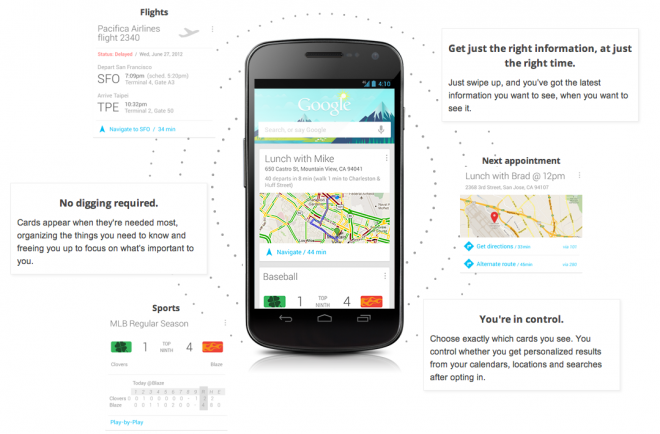
In my eyes, one of, if not the single best feature announced by Google yesterday during the day one I/O keynote was the introduction of Google Now. Google’s new card-based system will personalize your life, learn your habits, searches, today’s weather needs, anticipate your traffic concerns, guess your local transit direction needs and so much more.
Google’s official landing page for their Now service is now live and you can head on over to get the complete rundown on the service. Google Now is easily one of the standout features in Jelly Bean and we can only hope we all get a chance to test it out soon. Please be sure to leave your comments, and let us know what you think.
Check out the official Google Now webpage

Google Makes The Nexus 7 Tablet Official

Google has officially taken the wraps off of the Nexus 7, its first reference-grade tablet. The 7-inch slate is the first and currently only device shipping with Android 4.1 Jelly Bean, and takes advantage of its optimization for smaller tablet screens, magazines and movies it's also the first to ship with a finished Chrome for Android. Like what was widely suspected, the tablet is built by ASUS and mostly draws our attention in terms of what we get for the money: that quad-core Tegra 3, 1.2-megapixel front camera, NFC and 1280 x 800, IPS-based LCD are traits we'd normally look for in a pricier tablet. Google is asking just $199 for a 8GB model and $249 for a 16GB version that's a lot of speed for the money, especially with a $25 Google Play credit and a slew of bundled content. There's no SD card slot, however. 

Tuesday, June 26, 2012

Google Spills The Jelly Bean At Googleplex


We knew it from the beginning that Google will launch the next version of Android OS at the Google I/O 2012, but we still didn't know the final name of it. Though Google cleared the air today when they spilled some huge jelly beans in their front lawn, literally. And it's right in front of all the other Android statues,  Cupcake, Donut, Éclair, Froyo, Gingerbread, Honeycomb, Ice Cream Sandwich, and now it's time for some delicious Jelly Bean.
Hopefully, Google will rock the show this year by launching their first ever branded tablet, and also it will be the first tablet to feature Android Jelly Bean. This year Google I/O will come with so much surprises, so stay tuned with us and we will keep you up to date with every move.
And don't forget to share your thoughts about Jelly Bean in the comment below.
Source: Google+

Specs For Google Nexus Tablet Leak


Our friends over at Gizmodo Australia got some the leaked specs for the Google Nexus Tablet. According to Gizmodo Australia, it will be built by ASUS, and debuted at Google I/O.... As far as the complete specs:
  • 7-inch 1280×800 IPS Display
  • Android 4.1 Jelly Bean (not confirmed to be 5.0 just yet)
  • 1.3GHz Quad-Core Tegra 3 CPU
  • NVIDIA GPU
  • 1GB RAM
  • 8GB / 16GB Internal Storage
  • 1.2MP Front Camera
  • 8 Hours Battery Life
  • Wi-Fi a/b/g/n
  • NFC


Thursday, June 21, 2012

Android 4.1 Jelly Bean Outed By Google

Play-store
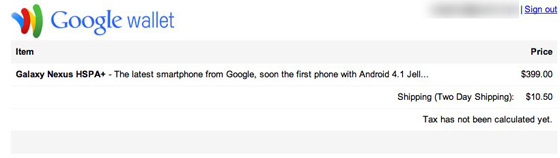
It seems that a possibly careless listing on the part of Google has just outed the next version of Android. It's outed as version 4.1, as Jell... we're going out on a limb here and saying Jelly Bean and more specifically, that the Samsung Galaxy Nexus will be the first phone to receive it. Wowzers. 
So, we've all been assuming for weeks upon weeks that we'd be hearing something about the next iteration of our favorite mobile platform. It isn't the biggest surprise in either name or version number, but it is a little surprising it has been outed in this way. 
So, are we going to see some sign of Android 4.1 Jelly Bean next week in San Francisco?

Tuesday, June 19, 2012

Google’s Nexus Tablet To Be Unveiled Next Week


Google chairman Eric Schmidt revealed in December that the company was working on its first own-brand tablet, and the Nexus 7 slate will finally be unveiled next week during the Google I/O developer conference, according to multiple reports. The last reaffirmation comes from DigiTimes, which has reported a number of details surrounding Google’s upcoming tablet that will seemingly prove accurate. 


The site’s anonymous supply chain sources have previously stated that Google’s next major Android release, Jelly Bean, would come in the second quarter, and it reported later that Nexus tablet shipments would begin in June ahead of a July launch. As is the case with Microsoft’s Surface tablet, which was unveiled on Monday, it remains to be seen how Google’s own hardware efforts will impact its Android partners, some of which already seem to be exploring different ways to separate themselves from the pack or even ramping up efforts with new platforms. Google I/O begins on June 27th.