Showing posts with label Siri. Show all posts

Thursday, January 16, 2014

Say Hello To The All-New Jawbone ERA

Color options for ERA by Jawbone bluetooth headsets.

ERA's HD audio delivers crystal clear sound for much more than just phone calls. Listen to music in the morning, catch up on podcasts while you catch up on chores, or ask Siri for advice when you're cooking dinner. With every word or note, ERA is a revelation in how you listen, and talk, through a Bluetooth® headset.

Life is full of noise. But conversations demand clarity. Wherever you are, whatever you're doing, your every word should be crisp, clear, and coherent.

Military-grade NoiseAssassin® eliminates background noise, so even if you're in a crowd, the only thing they'll hear on the other end is the sound of your voice.

ERA's HD audio delivers crystal clear sound for much more than just phone calls. Listen to music in the morning, catch up on podcasts while you catch up on chores, or ask Siri for advice when you're cooking dinner. With every word or note, ERA is a revelation in how you listen, and talk, through a Bluetooth® headset.

From home to the office, from airport to airport, our lives are spent on the move. So no matter how wonderful your wireless headset, it's worthless without power.

ERA's sleek charging case more than doubles its 4 hours of talk-time and protects it, so you'll always have power, even if you’re always on the go.

Life isn't one-size-fits-all, and every person deserves technology that adapts to their needs. The Jawbone App lets you customize ERA to make it your own and program easy access to Siri or Google Now for hands-free control. Plus, the built-in locator ensures you'll never lose it.
ERA isn't just our best headset ever, it's the best headset we've ever made for you.


Source: Jawbone


The smallest, lightest, most comfortable headset we've ever created. Advanced ear fittings feature a new design that uses the natural contour of the ear to create a secure fit so it's comfortable enough to wear all day.

The smallest, lightest, most comfortable headset we've ever created. Advanced ear fittings feature a new 


The smallest, lightest, most comfortable headset we've ever created. Advanced ear fittings feature a new design that uses the natural contour of the ear to create a secure fit so it's comfortable enough to wear all day.

The smallest, lightest, most comfortable headset we've ever created. Advanced ear fittings feature a new design that uses the natural contour of the ear to create a secure fit so it's comfortable enough to wear all day.

Sunday, January 27, 2013

How Siri Almost Became An Android Exclusive For Verizon


Details on the the history of Siri, including Steve Jobs' move to contact the company just three weeks after the independent app's launch, have surfaced over the last several years, but The Huffington Post has now published an extensive history of the technology and company that reveals a few other interesting details. 

The report outlines how Siri grew out of a Department of Defense project to integrate with 42 different web services to perform its virtual assistant services, many of which were discontinued when Apple scaled back the platform for inclusion in iOS. Apple has been relatively slow to build Siri's feature set back up, but has been making progress on the effort. 

Perhaps most interestingly, the report reveals that Siri was very nearly an Android exclusive for Verizon, but the deal was obviously broken when Steve Jobs and Apple moved quickly to acquire Siri.

In the fall of 2009, several months before Apple approached Siri, Verizon had signed a deal with the startup to make Siri a default app on all Android phones set to launch in the new year. When Apple swooped in to buy Siri, it insisted on making the assistant exclusive to Apple devices, and nixed the Verizon deal. In the process, it narrowly avoided seeing Siri become a selling point for smartphones powered by its biggest rival, Google. (Somewhere in the vaults of the wireless giant, there are unreleased commercials touting Siri as an Android add-on.)
The report goes on to discuss some of the challenges faced by Siri at Apple, including difficulties in negotiating partnerships with content providers, Apple's emphasis on broadening access to other countries and languages over pushing the technology forward for a smaller subset of users, and corporate politics that have resulted in the loss of some of Siri's biggest advocates at Apple. 

Siri is also facing strong competition from the Android platform of which it was almost a part. Google has moved quickly to develop its own virtual assistant capabilities in the form of Google Now, and many are looking for Apple to step up the pace of improvement with Siri in order to reestablish it in users' minds as a key advantage for Apple as it was touted at its 2011 launch on the iPhone 4S.


Source: MacRumors

Amazon Buys Speech Recognition Firm Ivona


Amazon on Thursday announced it is buying Ivona, a firm specializing in text-to-speech technology.
The Poland-based Ivona's technology verbalizes written text messages. Amazon has been using Ivona's technology for its Kindle e-readers since 2009. Ivona also supplies "Explore By Touch" and "Voice Guide" navigation for Kindle Fire models. Explore By Touch gives readers an auditory cue when they swipe their fingers across the Kindle Fire's menu (for instance, the title of a book would be read aloud if it was swiped.) In Voice Guide, any action the customer performs on the device is read aloud. In Amazon's example, when you open a new book, it would say "The Hunger Games. Book opened." Both features are aimed at vision-impaired customers.
While the technology appears to be the exact opposite of Apple's Siri, Amazon's purchase might signal increased hands-free features that could be employed on a rumored Amazon phone.
Terms of the deal were not disclosed.

Source: Mashables

Thursday, January 24, 2013

Siri, Almost A Verizon Droid Android Exclusive


The Huffington Post is running a story covering the past, present and future of Siri, sharing some interesting facts on the AI personality, including one that’s particularly relevant to Android users. According to the Huffington Post, before Apple absorbed the company behind Siri, Verizon had reached a deal to make the virtual assistant a Droid exclusive. In other words, Siri was originally destined for Android. Verizon went as far as shooting commercials centered around Siri before the deal was later canceled.
If Apple had never bought Siri, would Google have ever felt compelled to release Google Now? Would Siri have been a multi-platform virtual assistant, lost among the Evas, Robins, Jennies, Hals and S-Voices of the world? We’ll never know the answer to those questions, and it’s all for the best. Much like the platforms they run on, Siri and Google Now push each other to become better products. Google Now may trump Siri in terms of usefulness and functionality right now, but it may not always be that way. Who know what the future of smartphone interaction holds? I can tell you one thing, it doesn't hold the Verizon Motorola Droid 7 with Siri+. Right now, it feels like Android users really dodged the bullet on that one.

Saturday, January 12, 2013

The Story Of Google Now, Start To Finish


Google Now is a product/platform that really excites us. We can't say for sure that it will live up to the potential, but if it can, it could be something pretty special in the new field of intelligent push. Of course, Google didn't build this product alone, there was a long, strange journey to get here. Where Siri was a product that had an identity when Apple bought it and reimagined it for iOS, Google Now has been something of a Frankenstein monster pieced together from a number of products some built in-house, some acquired, and some built by personnel hired specifically for the job. 

There is a bit of an argument about this whole process, with some claiming that Google Now is better than Siri because it was built "from the ground up" by Google, whereas Apple just bought Siri. It's all a silly argument based on geek pride, but it did get us looking into the process by which these products came to be what they are. 

Of course, what these products are is something of a trouble spot as well, because people insist on pulling both under the heading of "personal assistant", and trying to compare them as similar. Such comparisons fall flat for us because "personal assistant" is too general a heading. A bike and a jet are both "transportation devices", but that doesn't mean it's a good idea to compare them. In this case, Siri is a tool for finding information and organizing your life, which is based on active participation. Google Now is a tool not only for finding info and organizing your life, but more importantly it is a platform which will passively learn your behavior and interests in order to have relevant information ready for you, without the need for actively searching. Sure, there is overlap in what these two products do, but that doesn't mean comparisons are necessary, or even useful.  

We can't really get behind the argument that one way is better than the other, because it quickly becomes a slippery slope. The problem is that at some point, an acquired product can't be attributed to the original creators anymore, even when the original creator comes along in the acquisition. The prime example for us is Android itself. Android was created by the Android team headed by Andy Rubin, then acquired as a fully functioning product by Google. Andy and the team still work for Google, but Android has become a wholly Google product. Similarly, Siri was bought by Apple as a fully functioning product, but to say that was the same app that now anthropomorphizes the iPhone just isn't correct. 

The bit about Siri 

As a standalone app back in 2010, Siri could make restaurant reservations, book movie tickets, get a taxi, find info or weather. Some of the functionality had to be removed from the app when Apple bought it, because Apple wasn't going to use services like Bing, Yahoo, or Google for search results, but in place of that functionality, Siri got deep integration into iOS, meaning options for scheduling, reminders, calling/messaging contacts, playing music, and dictation. As Siri matures, it is gaining back some of the partnerships that Apple ditched, but gaining more valuable partnerships along the way. Although key partnerships with services like OpenTable and MovieTickets are still missing, Yelp and Wikipedia are in the iOS version of Siri, and the biggest addition is in the partnership with Wolfram Alpha as a big knowledge base. 

The point is that for better or worse, Siri is nowhere near the same app that it was when Apple purchased it. Sure, the backbone of voice recognition powered by Nuance is still at the center of Siri, but what the app can do has changed dramatically. What we see in iOS is no longer the product of the Siri developers simply purchased by Apple and stuck into iOS, this is an Apple product with features and uses dictated by Apple. 

Now... Google Now 

On the other hand, Google didn't buy one singular product and transform it for Google Now. As we said, this product/platform is more of a Frankenstein monster made up of a number of acquisitions, hires, and in-house development that can be traced back at least 5 years. In many ways, Google Now is an initiative similar to Google+, which is intended to be a platform to unify a number of existing Google products and services, including search, places, travel, suggestions, and of course speech recognition

Where Apple has partnered with Nuance and its Dragon software for the speech recognition behind Siri, Google has taken the last 5 years to build its own speech database. That project began with the hiring of Mike Cohen in 2007. Cohen was actually a co-founder of Nuance. He spearheaded the Google initiative to build a speech recognition database, which began collecting data through GOOG-411 in 2007  the free place information service Google once ran before getting a ton of data through dictation and voice actions on Android over the past 2 years or so, not to mention contributions from Google Voice and its terrible voicemail transcriptions. Cohen left Google earlier this year, but the speech recognition work will go on. 

On the other side of the voice coin, Google also needed a nice voice to respond to users just like Siri does. Luckily, Google had purchased Phonetic Arts back in December of 2010. That purchase was originally made to make robo-voices sound better in Google Translate, as well as the accessibility text-to-speech option found in Android. Phonetic Arts did a lot of work making robo-voices sound better, and that technology has come in very handy with Google Now, because it does sound like the assistant voice is smoother than Siri. As the voice database was growing to a sufficient level, Google also needed to beef up search results. 

If you hadn't noticed, Google has been slowly transitioning from a search engine into more of a knowledge provider. More and more when you search, you'll not only get the search results, but an actual answer to your query, such as word definitions, sports scores, movie showtimes, and flight information. While some of that knowledge has come through partnerships and searchable content, big pieces of the Google Now puzzle came through acquisitions 

Flight information is gathered via searchable results from flightstats.com, but eventually, Google could move to its own information repo which it purchased in the form of ITA Software (acquired July 2010). ITA Software now powers Google's Flight Search for tickets, and that could easily become part of Google Now's results. Place results, which are a huge part of any mobile search product (because more and more "mobile" really just means "local") have also gotten a boost from a couple choice acquisitions. Google hired the entire team behind Ruba.com (
acquired May 2010), an online travel guide, in an effort to give local results a boost. Then, more recently, moves to purchase Clever Sense (acquired December 2011), makers of local recommendation app Alfred, and restaurant guide Zagat (acquired September 2011). Google notably had a falling out with Yelp, and the purchase of Zagat was the answer to that loss of local data. 

Possibly the biggest acquisition of all was Metaweb, which Google purchased in mid-2010. Apple of course has to partner with information services like Wikipedia, Wolfram Alpha, and Yelp, but it's Google's business to provide organized data and knowledge to users, and Metaweb is the future of that endeavor. Metaweb just recently made its debut within Google in the form of Google's Knowledge Graph and Semantic Search. Now, rather than searching for keywords, we're searching semantic objects, which means there should be better differentiation between homographs so Google now knows whether you're searching the meteorological "thunder" or the NBA Thunder. These results have shown up in the Knowledge Graph block to the right of standard results. 

These blocks of information have all made the pretty easy transitions into being "cards" in the Google Now UI. And, on that topic, we have to mention the hire of Matias Duarte in May 2010, who has been one of the strongest forces behind getting the traditionally engineer-oriented Google to make well-designed products. Matias has always loved the "card" metaphor, and so we feel pretty safe in assuming the cards in Google Now were his idea. For those of you that ever used webOS, you know that cards were a central metaphor of that platform (designed by Matias), then we saw the multitasking menu of Android change to cards when Matias arrived and now we get the cards of information as part of Google Now.

The information side of Google Now is pretty strange to follow, but the learning side of the platform is actually pretty easy, because it uses two things that Google has been cultivating for a long time now: web history and location services. Web history encompasses both your search history, and any visited pages from those search results, where location services is obviously looking at where you spend your time and where you travel. If you have an Android phone with location services enabled, Google probably already knows where you live and where you work, and all of that data can easily be found on your Latitude dashboard note: this is all private data that only you can see, Google doesn't share it. When you combine that location data with your personal calendar, and Google's ever expanding navigation options for driving, public transport, walking, and biking, you get a pretty powerful data set that only needs a bit of a nudge to predict what information you may need at a given time and place. 

Conclusion

We can't say that Google Now was completely built in-house by Google any more than Apple built Siri in-house. Both took very different development paths because of the nature of the product, the nature of the respective companies, and the resources available to each company. Google is a software company that has been working hard for years to learn who you are as an abstract entity, not as an individual, while Apple doesn't have that information to leverage and had to build a product that can essentially start to harvest that data. As we said before, we fully expect Siri to continue its transformation, and eventually become an intelligent push service like Google Now, but whatever the end point, the journey of Siri becoming a fully realized product is much cleaner than Google Now. Apple has always tended to work from a centralized format, creating one singular product designed for a purpose within the larger whole of the Apple ecosystem, while Google is a far more messy affair.

Google captures various services and products for a number of different reasons, and may not always have an overarching plan to bring everything together. Since Larry Page has stepped into the CEO office, that has begun to change, but it can still be a pretty long and windy road leading from products, acquisitions, and hires into a cohesive platform like Google Now. 

Tuesday, July 10, 2012

How Google Now Was Built, Start To Finish


Google Now is a product/platform that really excites us. We can't say for sure that it will live up to the potential, but if it can, it could be something pretty special in the new field of intelligent push. Of course, Google didn't build this product alone, there was a long, strange journey to get here. Where Siri was a product that had an identity when Apple bought it and reimagined it for iOS, Google Now has been something of a Frankenstein monster pieced together from a number of products some built in-house, some acquired, and some built by personnel hired specifically for the job. 

There is a bit of an argument about this whole process, with some claiming that Google Now is better than Siri because it was built "from the ground up" by Google, whereas Apple just bought Siri. It's all a silly argument based on geek pride, but it did get us looking into the process by which these products came to be what they are. 

Of course, what these products are is something of a trouble spot as well, because people insist on pulling both under the heading of "personal assistant", and trying to compare them as similar. Such comparisons fall flat for us because "personal assistant" is too general a heading. A bike and a jet are both "transportation devices", but that doesn't mean it's a good idea to compare them. In this case, Siri is a tool for finding information and organizing your life, which is based on active participation. Google Now is a tool not only for finding info and organizing your life, but more importantly it is a platform which will passively learn your behavior and interests in order to have relevant information ready for you, without the need for actively searching. Sure, there is overlap in what these two products do, but that doesn't mean comparisons are necessary, or even useful.  

We can't really get behind the argument that one way is better than the other, because it quickly becomes a slippery slope. The problem is that at some point, an acquired product can't be attributed to the original creators anymore, even when the original creator comes along in the acquisition. The prime example for us is Android itself. Android was created by the Android team headed by Andy Rubin, then acquired as a fully functioning product by Google. Andy and the team still work for Google, but Android has become a wholly Google product. Similarly, Siri was bought by Apple as a fully functioning product, but to say that was the same app that now anthropomorphizes the iPhone just isn't correct. 

The bit about Siri 

As a standalone app back in 2010, Siri could make restaurant reservations, book movie tickets, get a taxi, find info or weather. Some of the functionality had to be removed from the app when Apple bought it, because Apple wasn't going to use services like Bing, Yahoo, or Google for search results, but in place of that functionality, Siri got deep integration into iOS, meaning options for scheduling, reminders, calling/messaging contacts, playing music, and dictation. As Siri matures, it is gaining back some of the partnerships that Apple ditched, but gaining more valuable partnerships along the way. Although key partnerships with services like OpenTable and MovieTickets are still missing, Yelp and Wikipedia are in the iOS version of Siri, and the biggest addition is in the partnership with Wolfram Alpha as a big knowledge base. 

The point is that for better or worse, Siri is nowhere near the same app that it was when Apple purchased it. Sure, the backbone of voice recognition powered by Nuance is still at the center of Siri, but what the app can do has changed dramatically. What we see in iOS is no longer the product of the Siri developers simply purchased by Apple and stuck into iOS, this is an Apple product with features and uses dictated by Apple. 

Now... Google Now 

On the other hand, Google didn't buy one singular product and transform it for Google Now. As we said, this product/platform is more of a Frankenstein monster made up of a number of acquisitions, hires, and in-house development that can be traced back at least 5 years. In many ways, Google Now is an initiative similar to Google+, which is intended to be a platform to unify a number of existing Google products and services, including search, places, travel, suggestions, and of course speech recognition

Where Apple has partnered with Nuance and its Dragon software for the speech recognition behind Siri, Google has taken the last 5 years to build its own speech database. That project began with the hiring of Mike Cohen in 2007. Cohen was actually a co-founder of Nuance. He spearheaded the Google initiative to build a speech recognition database, which began collecting data through GOOG-411 in 2007  the free place information service Google once ran before getting a ton of data through dictation and voice actions on Android over the past 2 years or so, not to mention contributions from Google Voice and its terrible voicemail transcriptions. Cohen left Google earlier this year, but the speech recognition work will go on. 

On the other side of the voice coin, Google also needed a nice voice to respond to users just like Siri does. Luckily, Google had purchased Phonetic Arts back in December of 2010. That purchase was originally made to make robo-voices sound better in Google Translate, as well as the accessibility text-to-speech option found in Android. Phonetic Arts did a lot of work making robo-voices sound better, and that technology has come in very handy with Google Now, because it does sound like the assistant voice is smoother than Siri. As the voice database was growing to a sufficient level, Google also needed to beef up search results. 

If you hadn't noticed, Google has been slowly transitioning from a search engine into more of a knowledge provider. More and more when you search, you'll not only get the search results, but an actual answer to your query, such as word definitions, sports scores, movie showtimes, and flight information. While some of that knowledge has come through partnerships and searchable content, big pieces of the Google Now puzzle came through acquisitions 

Flight information is gathered via searchable results from flightstats.com, but eventually, Google could move to its own information repo which it purchased in the form of ITA Software (acquired July 2010). ITA Software now powers Google's Flight Search for tickets, and that could easily become part of Google Now's results. Place results, which are a huge part of any mobile search product (because more and more "mobile" really just means "local") have also gotten a boost from a couple choice acquisitions. Google hired the entire team behind Ruba.com (
acquired May 2010), an online travel guide, in an effort to give local results a boost. Then, more recently, moves to purchase Clever Sense (acquired December 2011), makers of local recommendation app Alfred, and restaurant guide Zagat (acquired September 2011). Google notably had a falling out with Yelp, and the purchase of Zagat was the answer to that loss of local data. 

Possibly the biggest acquisition of all was Metaweb, which Google purchased in mid-2010. Apple of course has to partner with information services like Wikipedia, Wolfram Alpha, and Yelp, but it's Google's business to provide organized data and knowledge to users, and Metaweb is the future of that endeavor. Metaweb just recently made its debut within Google in the form of Google's Knowledge Graph and Semantic Search. Now, rather than searching for keywords, we're searching semantic objects, which means there should be better differentiation between homographs so Google now knows whether you're searching the meteorological "thunder" or the NBA Thunder. These results have shown up in the Knowledge Graph block to the right of standard results. 

These blocks of information have all made the pretty easy transitions into being "cards" in the Google Now UI. And, on that topic, we have to mention the hire of Matias Duarte in May 2010, who has been one of the strongest forces behind getting the traditionally engineer-oriented Google to make well-designed products. Matias has always loved the "card" metaphor, and so we feel pretty safe in assuming the cards in Google Now were his idea. For those of you that ever used webOS, you know that cards were a central metaphor of that platform (designed by Matias), then we saw the multitasking menu of Android change to cards when Matias arrived and now we get the cards of information as part of Google Now.

The information side of Google Now is pretty strange to follow, but the learning side of the platform is actually pretty easy, because it uses two things that Google has been cultivating for a long time now: web history and location services. Web history encompasses both your search history, and any visited pages from those search results, where location services is obviously looking at where you spend your time and where you travel. If you have an Android phone with location services enabled, Google probably already knows where you live and where you work, and all of that data can easily be found on your Latitude dashboard note: this is all private data that only you can see, Google doesn't share it. When you combine that location data with your personal calendar, and Google's ever expanding navigation options for driving, public transport, walking, and biking, you get a pretty powerful data set that only needs a bit of a nudge to predict what information you may need at a given time and place. 

Conclusion

We can't say that Google Now was completely built in-house by Google any more than Apple built Siri in-house. Both took very different development paths because of the nature of the product, the nature of the respective companies, and the resources available to each company. Google is a software company that has been working hard for years to learn who you are as an abstract entity, not as an individual, while Apple doesn't have that information to leverage and had to build a product that can essentially start to harvest that data. As we said before, we fully expect Siri to continue its transformation, and eventually become an intelligent push service like Google Now, but whatever the end point, the journey of Siri becoming a fully realized product is much cleaner than Google Now. Apple has always tended to work from a centralized format, creating one singular product designed for a purpose within the larger whole of the Apple ecosystem, while Google is a far more messy affair.

Google captures various services and products for a number of different reasons, and may not always have an overarching plan to bring everything together. Since Larry Page has stepped into the CEO office, that has begun to change, but it can still be a pretty long and windy road leading from products, acquisitions, and hires into a cohesive platform like Google Now. 

Thursday, June 28, 2012

Google Now, Google's Android 4.1 Siri Competitor


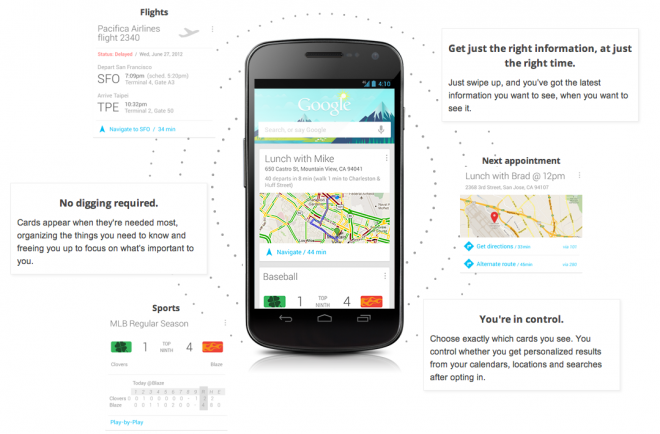
In my eyes, one of, if not the single best feature announced by Google yesterday during the day one I/O keynote was the introduction of Google Now. Google’s new card-based system will personalize your life, learn your habits, searches, today’s weather needs, anticipate your traffic concerns, guess your local transit direction needs and so much more.
Google’s official landing page for their Now service is now live and you can head on over to get the complete rundown on the service. Google Now is easily one of the standout features in Jelly Bean and we can only hope we all get a chance to test it out soon. Please be sure to leave your comments, and let us know what you think.
Check out the official Google Now webpage

Tuesday, June 19, 2012

Google To Introduce Siri Competitor For Android

This week it appears that someone at the Wall Street Journal has head from a reliable source that Google’s own Siri competitor known internally as codename Majel, has had its development plans accelerated. 


What this could mean for you, the reader, is that we’ll see said competitor at the next big Google event, that being the developer event known as Google I/O coming up on the 27th of June. For those of you that don’t know, the codename for this project is a reference to Majel Barrett, also known Nurse Christine Chapel in the original Star Trek television series and much more importantly the voice of the ship’s computer as well.

Tuesday, June 12, 2012

Apple Brings Siri To The iPad


Apple announced that as part of iOS 6, Siri will be available on the iPad in addition to the iPhone. It's part of a larger update to Siri, allowing the voice-controlled app to now do everything from launch apps to report the batting average of your favorite baseball players. Apple's Scott Forstall mentioned that Siri was coming to "the new iPad," so it sounds like older iPad owners might need to upgrade to get all the new features.

Turn-By-Turn Navigation Added To Maps In iOS 6

Yesterday at WWDC, Apple showed off iOS 6 for the first time, and we've got everything you need to know about iOS6. You'll find a brand new Maps app with turn-by-turn navigation, shared Photo Streams, new FaceTime features, and much more. iOS 6 was available for developers as of yesterday.


Apple launched its own Maps app in conjunction with iOS 6, and one of the new highlight features is turn-by-turn navigation. In addition to the standard turn-by-turn directions, and a "Quick Route" button on search results, you'll also be able to get directions from Siri. You can tell Siri where to navigate you, or even ask "are we there yet?" and find out how long it'll be before you arrive. Everything works from the lock screen, too. There's a persistent ETA at the top of the screen, and has a look and feel much more elegant than any existing GPS software we've seen before. It's all baked into Apple's new mapping system, one of the biggest announcements from today's WWDC keynote.

Tuesday, May 29, 2012

Foxconn Begins Taking Orders For Apple TV


Apple’s Chinese manufacturing partner Foxconn has reportedly begun accepting orders to build an Apple TV set, according to Chinese news website Sina. The publication’s sources claim the long rumored iTV is currently in the “trial production stage,” however more details were not given. Earlier this month Foxconn’s CEO denied that his company would soon begin manufacturing a television for Apple.


 It has long been rumored that the Cupertino-based company was looking to enter the TV market with an HDTV that will reportedly look much like the company’s current LED Cinema Display. The device is said to feature an aluminum casing, iOS, Siri voice controls and an iSight camera for FaceTime video chats. Earlier reports claim that the device would debut later this year, however some reports peg it to launch in 2014.

Saturday, May 12, 2012

Apple To Introduce Siri For iPad With iOS 6


The introduction of iOS 6 won’t just mark Apple’s breakaway from Google Maps, it’ll also see Siri possibly leave beta and develop into the voice-assistant fans have been waiting for. To do that, the Cupertino company is reportedly preparing to unveil the Siri API, which would open up a whole realm of new possibilities for app developers. Even better, Apple has finally decided to bestow Siri upon the millions of iPad owners around the world.

According to TechCrunch, iOS 6 which is being referred to as Sundance behind closed doors will give app developers access to Siri’s functionality, marking a departure from what Apple’s service currently offers. Think of being able to update your Twitter status just through Siri, no typing required.
Meanwhile, Siri for iPad seemed like a matter of time, especially with the introduction of voice dictation on Apple’s latest iPad. Apparently, Apple’s struggled more with Siri’s UI than actual functionality on the iPad, which is why it has taken the company so long.
Apple’s World Wide Developers Conference is about a month away, so expect to hear more about Siri’s coming-of-age when the week-long event kicks off.

Friday, May 11, 2012

Apple iTV Confirmed Launch By Foxconn


Foxconn Technology Group founder and chief executive Terry Gou has reportedly gone on record in stating that his company will soon begin manufacturing a television for Apple. Production has not yet begun, China Dailyreports, and the electronics manufacturing giant is currently preparing its facilities for Apple’s HDTV. The site claims Gou made the comments during a press conference in Shanghai on Friday. Apple’s long rumored HDTV, or “iTV” as it is often called, will reportedly look much like the company’s current LED Cinema Display. It is said to feature an aluminum casing, iOS, voice-powered remote control features courtesy of Siri, and an iSight camera for FaceTime video chats. Earlier reports claim that the device will debut later this year, though another recent report suggests that it might not launch until 2014.

Sunday, March 4, 2012

Google's Majel Reportedly Now Called Assistant


Last year we reported that Google was working on a virtual assistant for Android in response to Apple’s Siri. Later we learned that the project was codenamed Majel when one of our sources told us it was already in testing and a possible launch was imminent. For months no new details were leaked until this week when Alexia Tsotsis of TechCrunch reported that the service will now be called Assistant.


According to an unnamed source, Tsotsis says the project is being led by the Android team along with the help of search engineer Amit Singhal. If you have been following our Majel coverage, that is the same Singhal that said, “My dream has always been to build the Star Trek computer.”
Google’s own Matias Duarte previously discussed how their approach was different than Apple’s. Duarte said, “The metaphor I like to take is – if it’s Star Wars, you have these robot personalities like C-3PO who runs around and he tries to do stuff for you, messes up and makes jokes, he’s kind of a comic relief guy. Our approach is more like Star Trek, right, starship Enterprise; every piece of computing surface, everything is voice-aware. It’s not that there’s a personality, it doesn’t have a name, it’s just ‘Computer’.”
Tsotsis’ source says Google’s Assistant has three parts which include:
  1. Get the world’s knowledge into a format a computer can understand.
  2. Create a personalization layer — Experiments like Google +1 and Google+ are Google’s way of gathering data on precisely how people interact with content.
  3. Build a mobile, voice-centered “Do engine” (‘Assistant’) that’s less about returning search results and more about accomplishing real-life goals.
Singhal described one of these “do engine” scenarios by saying, “I would be able to walk up to a computer, and say, ‘Hey, what is the best time for me to sow seeds in India, given that monsoon was early this year?’ And once we can answer that question (which we don’t today), people will be looking for answers to even more complex questions. These are all genuine information needs. Genuine questions that if we – Google – can answer, our users will become more knowledgeable and they will be more satisfied in their quest for knowledge.”

Thursday, January 12, 2012

Dragon Go! Is a Better Alternative To Siri Than Iris And Skyvi


Dragon Go! is Nuance Software's foray into the voice/information retrieval app game. You speak what you want and Dragon Go! attempts to get you there.
While not terribly more accurate at guessing what you spoke than Iris or Skyvi, Dragon Go! features Dragon Carousel, a multi-tabbed searching experience that will search among many different providers. So if your answer wasn't on one of them, you can just tap a different search tab and the result should be already available.
It does a pretty good job of guessing things you might want to do based on your search. For example, "show movie times for Nashville, TN" pops up a list of what theaters are closet to me, show times, and purchase links on Fandango. "Is it going to snow?" brings up Accuweather for the area and a Twitter feed tagged with the city I'm in. One of the interesting searches they have is "what are the planes flying overhead," which will return a Wolfram Alpha tab with a list of everything in your general area.


While not a huge leap over the competition, Dragon Go! does come out swinging with Nuance Software's Dragon Naturally Speaking engine, which seems to be a bit more accurate at picking up language than Google's search.
Dragon Go! does not currently work correctly with Ice Cream Sandwich based ROMs, but support is planned in the near future.

Download Links: Market (phone) | Market (web)

Saturday, December 31, 2011

“Official” Siri For Android App removed from Android Market


Most Android owners don’t seem to suffer from Siri-envy, but try telling that to copycat developers. Ever since the popular fruit phone landed on the Now Network with its chatty digital assistant, the Android Market has been flooded with more than a fair share of generic doppelgangers. Sadly some people go farther than others.
Perhaps a sarcastic spoof of the iPhone 4S’ exclusive software, “Siri for Android” uses Apple’s official Siri icon to launch Android’s pre-existing voice control software. This “app” doesn’t do anything that your phone can’t already do. However, if you feel like having a laugh or two, you can hit the Android Market and install “Siri” on your EVO 3D or PHOTON. We suggest that you act fast, as we suspect the folks from Cupertino’s legal team won’t be taking too kindly to this new addition to the Android Market.
Update: Siri for Android has already been removed from the Android App Market.

Tuesday, December 13, 2011

Google’s response to Siri is codenamed Majel


Google’s response to Apple’s Siri voice assistant several months ago and over the last couple weeks I received further details about the secret project. For starters it is codenamed Majel, which comes from Majel Barrett-Roddenberry, better known as the voice of the Federation Computer from Star Trek.
Majel is an evolution of Google’s Voice Actions that is currently available on most Android phones with the addition of natural language processing. Where Voice Actions required you to issue specific commands like “send text to…” or “navigate to…”, Majel will allow you to perform actions in your natural language similar to how Siri functions.
Speaking of actions, it sounds like only Google search queries will be included with the initial release, that could come as soon as this year. I say this year because I’ve heard that engineers at Google X are working around the clock on finishing the first release and the NYTimes previously reported that one product would be released by Google X this year.
December if nearly half over, so a January or February release might be more realistic. Other more advanced features like controlling phone actions and applications with natural language commands are expected to come later.
Google’s Matias Duarte had previously given hints about the future of Android’s voice actions in an interview with Slashgear. Matias said, “Our approach is more like Star Trek, right, starship Enterprise; every piece of computing surface, everything is voice-aware. It’s not that there’s a personality, it doesn’t have a name, it’s just Computer.”
I had previously speculated that Google’s approach might actually include some kind of animated avatar, but it appears I was way off on that one. However, we still expect greatly enhanced computer voices that sound more human and fluid, thanks to Google’s acquisition of Phonetic Arts, which occurred at the tail end of 2010.

Thursday, November 17, 2011

Skyvi is a better alternative to Siri than Iris


Ss-480-0-1[1]Skyvi is an Android-based Siri alternative that seems to make up several of the answers, but otherwise functions in a similar way. Unfortunately, getting useful information from Iris has been next to impossible for me. Skyvi, on the other hand, is leaps and bounds further along the developmental road at the moment, with Twitter and Facebook integration and an ability to answer most questions I threw at it.
Here are my last few Skyvi questions/requests and answers:
  • How far is Mars? 1.441AU
  • Where is the best Chinese food in Nashville? (it gave me several addresses)
  • Tweet that I love my wife. Twitter shows "that I love my wife"
  • What is the capital of Kansas? Topeka
  • Where am I right now? Nashville, Tennessee
  • How long is Route 66? 60 minutes (it gave the TV show's length)
I've had some issues with a few questions, such as asking for a decent lasagna recipe, and there seems to be a lack of maps or navigation ability, but as a work-in-progress I'd say this is at about two-thirds of what it needs to be to compete with Siri in a very, very short development time.

Img[1]When it doesn't know the answer it tends to get a bit sassy with you, which I believe the developers call "personality." It can't set an alarm on the phone or speak to you either; however, I actually consider that an improvement over Siri and Iris's voices.
The Facebook integration is pretty neat. You can say "read my Facebook" and see a live stream; you're then able to comment on people's posts by speaking. Unfortunately, the speech recognizer sometimes flubs what you want and there's no "delete comment" evident. But you can say something like "read Bob Bob's Facebook" and it will pull up posts only by him, which is quite useful.
All in all it's a fairly nifty little app so far, and until Siri is released in one form or another on Android, if you've got to have it, then I think Skyvi is probably your best free bet.

Download link: Market (web)